CFOs and founders don’t need another pitch about “crypto.” They need payment rails that close invoices faster, lower acceptance costs, and reconcile cleanly into ERP systems. Stablecoin-ready crypto commerce platforms and billing software do exactly that—without forcing the finance team to learn a new language.
Why stablecoins now Stablecoins like USDC and EURC are designed for settlement, not speculation. They move over public networks with finality and can be programmatically reconciled. In Singapore and Hong Kong, regulatory clarity is improving; MAS has introduced a stablecoin framework, and Hong Kong is moving toward specific guidance. This means finance teams can set policies with fewer unknowns.
The operational problem they solve If you sell cross-border, you know the pain:
- Card fees of 2.5–3.5%, plus chargebacks and rolling reserves.
- SWIFT wires that land after 1–3 days with $20–$50 in fees and unexpected FX.
- Fragmented reconciliation across gateways and bank accounts.
Stablecoin acceptance changes the math.
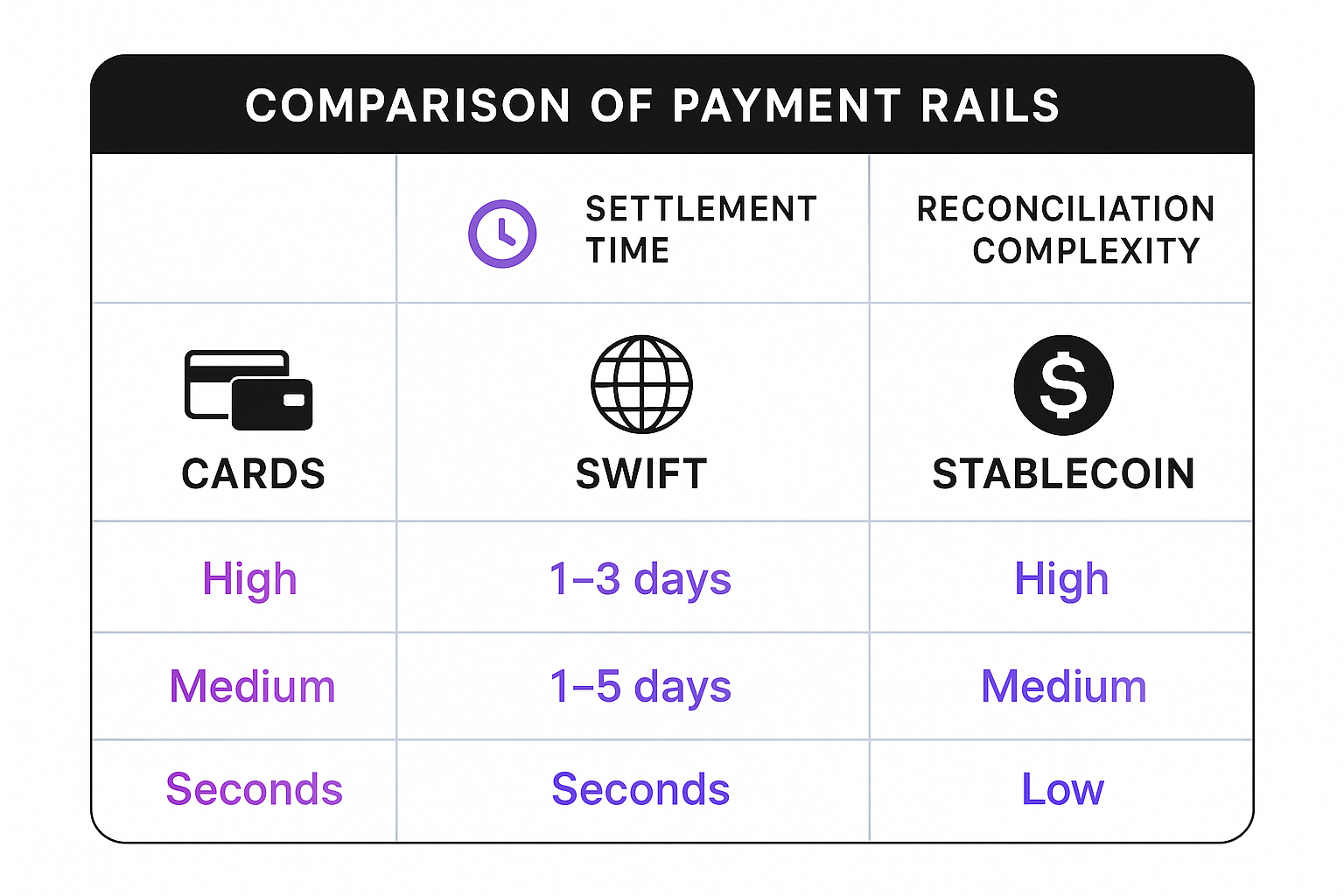
- Cards: 2.9% + $0.30 fee; T+2 settlement; chargebacks; auto-reconciliation via gateway exports; moderate FX slippage.
- SWIFT: $20–$50 per wire; 1–3 days; manual reconciliation; FX spread 50–150 bps.
- Stablecoin (USDC): ~0.1% processing fee (illustrative) + network fee $0.05–$2; settlement in minutes; programmatic reconciliation; FX optional at either side.
Not a silver bullet—just a new default rail There are caveats: refunds are push-based (no card-like chargebacks), on-chain addresses must be screened, and treasury needs rules for conversion to fiat. But the trade-offs are manageable with the right stack.
What “crypto commerce platform + billing software” actually gives you
- Stablecoin checkout and invoicing: Accept USDC/EURC on multiple networks. Hosted checkout links and API-based invoicing that embed KYC as needed.
- Tax and FX controls: Line-item VAT/GST handling and optional on-the-fly conversion to USD, SGD, or EUR.
- Reconciliation you can audit: Each invoice payment maps to a unique on-chain reference, auto-posted into NetSuite, Xero, or SAP with supporting attestations.
- Treasury rules: Convert a portion to bank fiat within defined SLAs; retain the rest for vendor payouts or treasury ops. Example policy (illustrative): Convert 70% on receipt; keep 30% in USDC to pay suppliers on-chain.
- Compliance guardrails: Address screening, Travel Rule routing for large transfers, and jurisdictional policy enforcement.
A quick scenario (illustrative numbers) A Singapore SaaS vendor bills $250,000/month across the US and EU:
- Previously: 60% cards at 2.9% = $4,350 in fees; 40% wires with $20 average fee = $2,000; total fees ≈ $6,350/month, with 1–3 day settlement delays.
- With stablecoins: 50% adoption in 90 days; processing 50% of volume at 0.1% + $1 average network fee per invoice yields ≈ $175/month on $125,000; blended total fees drop to ≈ $3,400/month (illustrative). DSO improves by 1.5 days because payments settle within an hour.
Money should move as quickly as your contracts.
How to pilot without breaking your finance stack
- Set a stablecoin policy: Which assets (e.g., USDC), which networks, refund rules, and conversion thresholds.
- Start with invoicing: Enable stablecoin invoices for enterprise customers that already ask for crypto payment options.
- Map accounting: Define GL accounts for on-chain receipts, realized/unrealized FX, and conversion fees.
- Automate reconciliations: Use unique payment references and webhooks to post directly to your ERP.
- Measure real outcomes: Track DSO change, fee savings, write-offs, and ops time saved per month. Aim for a 90-day pilot with explicit targets (e.g., 1–2 day DSO reduction; 30–50% lower acceptance costs, both illustrative).
Where STABO.io fits STABO.io offers a stablecoin-ready commerce and billing layer built for finance teams: hosted checkout and API invoicing, ERP integrations, screening and Travel Rule partners, and treasury policies you can enforce. It’s designed so a CFO can explain it in one slide to the audit committee.
The point isn’t to “do crypto.” It’s to settle revenue predictably, cut avoidable fees, and give your team better payment control across borders. Once that’s in place, the rest is just finance doing what it does best—allocating capital with fewer frictions.